Ceramic Tile Cutting Machines: Types, Applications & Buying Guide
A practical guide to industrial ceramic and porcelain tile cutting equipment, including bridge saws, diamond blade machines, CNC systems, waterjet cutting, automatic production lines, and machinery sourcing from China.
Ceramic tile cutting machines are essential equipment for tile manufacturers, porcelain slab processors, building material workshops, and architectural surface fabricators.
They are used to cut ceramic and porcelain products into required dimensions, produce specific shapes, prepare installation components, and support downstream processing.
However, ceramic tile cutting is not a single manufacturing process.
A workshop cutting standard ceramic floor tiles has different equipment requirements from a factory processing large-format porcelain slabs or producing complex decorative patterns.
Some machines are designed for straight cutting, while others support angled cuts, curved profiles, openings, or intricate geometries.
Industrial machines also vary in automation level, cutting technology, processing accuracy, material compatibility, and operating cost.
The right ceramic tile cutting machine should be selected according to the material, cutting geometry, finished edge requirements, production volume, and total operating cost—not simply the advertised cutting speed.
This guide explains the main types of ceramic tile cutting machines, their applications, technical specifications, and how international buyers can evaluate new and used equipment from China.
1. What Is a Ceramic Tile Cutting Machine?
A ceramic tile cutting machine is equipment used to separate, size, or shape ceramic and porcelain materials.
Depending on the machine design, cutting may be performed using a diamond blade, abrasive waterjet, scoring and breaking mechanism, or another suitable cutting process.
Industrial cutting equipment may operate as a standalone machine or as part of a larger production line.
1.1 Common Applications
Ceramic tile cutting machines are used for:
- Floor tile sizing
- Wall tile processing
- Porcelain slab fabrication
- Kitchen countertop processing
- Bathroom surface fabrication
- Decorative tile production
- Architectural cladding components
- Stair treads and skirting
- Mosaic and custom tile patterns
- Openings and special-shaped components
Different applications require different machine configurations.
1.2 Ceramic Tile vs Porcelain Tile Cutting
Ceramic and porcelain tiles vary in composition, density, water absorption, thickness, and mechanical properties.
Porcelain tiles are generally denser and have lower water absorption than many conventional ceramic tiles.
However, cutting performance depends on the specific product rather than the label alone.
Important considerations include material hardness, thickness, internal structure, surface finish, and the tendency to chip or crack.
Buyers should provide actual sample materials when evaluating equipment.
1.3 Industrial Cutting vs Installation Tools
Industrial ceramic cutting equipment should be distinguished from portable tools used by tile installers.
Portable manual cutters and small wet saws may be suitable for construction-site work.
Industrial cutting machines are generally designed for greater production capacity, repeatability, specialized processing, or automation.
2. Main Types of Ceramic Tile Cutting Machines
Different cutting technologies are suited to different materials and production requirements.
2.1 Manual Tile Cutters
Manual tile cutters typically use a scoring wheel and breaking mechanism.
They are commonly used for suitable ceramic or porcelain tiles in installation and small-scale processing applications.
Typical applications:
- Straight cuts
- On-site tile installation
- Small workshops
- Occasional tile resizing
Advantages:
- Portable
- Relatively low investment
- No large electrical installation
- Simple operation for compatible materials
Limitations:
- Limited cutting geometry
- Material and thickness restrictions
- Operator-dependent results
- Unsuitable for many industrial production requirements
2.2 Wet Tile Saws
Wet tile saws use a rotating cutting blade, commonly diamond-based, with water supplied for cooling and dust suppression.
They may be suitable for ceramic and porcelain cutting, depending on the blade and machine.
Typical applications:
- Straight cuts
- Selected angled cuts
- Workshop tile fabrication
- Construction and renovation projects
Important selection factors include cutting length, blade size, motor capability, water supply, table stability, and edge quality.
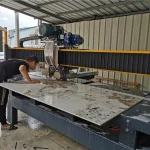
2.3 Bridge Saw Cutting Machines
Bridge saws are widely used in stone and large-format slab fabrication.
Suitable configurations can also process porcelain slabs and other compatible ceramic materials.
A bridge saw typically moves the cutting head or blade assembly along a guided structure.
Depending on the model, it may support straight cuts, miters, and programmed operations.
Typical applications:
- Large-format porcelain slabs
- Countertop fabrication
- Architectural panels
- Straight and angled cutting
- Repetitive slab processing
Buyers should confirm the machine’s actual suitability for porcelain rather than assuming that every stone bridge saw can process all ceramic slabs.
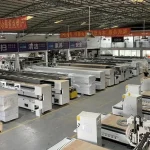
2.4 Automatic Ceramic Tile Cutting Lines
Automatic cutting lines are designed for continuous or repeated tile processing.
They may include:
- Automatic feeding
- Conveyor systems
- Positioning
- Cutting stations
- Water cooling
- Separation
- Unloading
- Sorting
These systems can be useful where consistent throughput is required.
However, actual output depends on tile dimensions, cutting patterns, material behavior, and downstream handling.
2.5 CNC Tile Cutting Machines
CNC cutting equipment uses programmed control to position and move the cutting tool or workpiece.
Depending on the configuration, CNC systems may support:
- Repeated straight cuts
- Angled cutting
- Selected shapes
- Automated positioning
- Programmed cutting sequences
CNC is a control method rather than one specific cutting technology.
A CNC machine may use a diamond blade, waterjet, or another suitable cutting process.
2.6 Waterjet Tile Cutting Machines
Waterjet cutting uses a high-pressure water stream, often mixed with abrasive material, to cut suitable hard materials.
Abrasive waterjet systems are particularly useful for complex shapes and decorative cutting.
Typical applications:
- Curved profiles
- Decorative patterns
- Custom openings
- Intricate inlays
- Architectural components
Waterjet equipment may offer flexibility for shapes that are difficult to produce with conventional circular saw blades.
However, operating costs can include abrasive consumption, water treatment, pump maintenance, and replacement parts.
2.7 Specialized Tile Cutting and Splitting Equipment
Some production processes use specialized equipment for narrow strips, mosaics, skirting, or other standardized products.
These machines should be evaluated according to the exact material and product requirements.
3. Comparison of Ceramic Tile Cutting Technologies
Machine Type | Main Cutting Method | Suitable Applications | Main Considerations |
Manual Cutter | Scoring and breaking | Installation, selected straight cuts | Material compatibility and operator skill |
Wet Tile Saw | Diamond blade | Small-scale cutting | Blade, water and cutting dimensions |
Bridge Saw | Guided cutting blade | Large slabs, straight and angled cuts | Slab handling and machine geometry |
Automatic Cutting Line | Industrial cutting stations | Repetitive production | Throughput and integration |
CNC Cutting Machine | Program-controlled cutting | Repeatable or programmed shapes | Actual cutting technology and software |
Abrasive Waterjet | Abrasive water stream | Complex patterns and openings | Pump, abrasive and operating cost |
Specialized Cutting Machine | Application-specific | Strips, mosaics and special products | Product limitations |
3.1 Which Machine Is Best for Straight Cuts?
For simple straight cuts, a suitable diamond blade cutting machine may be an effective choice.
For high-volume production, automated feeding and cutting systems may improve consistency and throughput.
3.2 Which Machine Is Best for Large Porcelain Slabs?
A properly configured bridge saw or other large-format slab cutting system may be appropriate.
The machine must support the slab dimensions, thickness, handling requirements, and cutting geometry.
3.3 Which Machine Is Best for Complex Patterns?
Abrasive waterjet systems are often considered for complex shapes, curves, and decorative inlays.
However, cutting time, kerf width, edge quality, and operating cost should be evaluated.
3.4 Which Machine Is Best for Mass Production?
For repeated tile sizes and cutting patterns, an automatic cutting line may be suitable.
The correct configuration depends on the complete manufacturing workflow.
4. Understanding Different Tile Materials and Cutting Requirements
Material compatibility is one of the most important equipment selection factors.
4.1 Glazed Ceramic Tiles
Glazed tiles have a surface layer that may be vulnerable to chipping during cutting.
Blade selection, cutting parameters, support, and handling can affect edge quality.
4.2 Porcelain Tiles
Porcelain products can require suitable cutting tools and stable machining conditions.
Some porcelain slabs may also be sensitive to handling stresses and localized damage.
4.3 Large-Format Porcelain Slabs
Large-format slabs require attention to:
- Slab dimensions
- Thickness
- Workpiece support
- Lifting and handling
- Cutting sequence
- Vibration
- Edge quality
- Breakage prevention
The cutting machine and material handling equipment should be evaluated together.
4.4 Textured and Decorative Tiles
Textured surfaces may create challenges for workholding, measurement, and surface protection.
Machine suitability should be confirmed using representative samples.
4.5 Material Compatibility Checklist
Before requesting a quotation, provide:
- Tile type
- Tile dimensions
- Thickness range
- Surface finish
- Required cutting shapes
- Required tolerances
- Expected output
- Representative material samples
5. Important Technical Specifications of Tile Cutting Machines
Technical specifications should be compared using the same materials and operating assumptions.
5.1 Maximum Cutting Dimensions
Confirm the maximum supported tile length, width, and thickness.
For large slabs, verify the actual usable cutting area and material handling clearance.
5.2 Cutting Accuracy
Cutting accuracy may include dimensional deviation, straightness, angular accuracy, and repeatability.
Suppliers should define the test method and operating conditions.
5.3 Cutting Speed
Cutting speed depends on material properties, thickness, tool selection, and required edge quality.
Higher speed is not always desirable if it increases chipping or tool wear.
5.4 Blade and Tooling System
For diamond blade equipment, confirm:
- Blade diameter
- Arbor compatibility
- Tool specification
- Supported materials
- Replacement availability
- Recommended operating conditions
For waterjet equipment, evaluate the pump, cutting head, abrasive delivery system, and related consumables.
5.5 Water and Dust Management
Wet cutting equipment requires appropriate water supply, drainage, and slurry handling.
Dust-generating processes require suitable engineering controls.
5.6 Electrical and Utility Requirements
Confirm voltage, frequency, connected load, water supply, compressed air, and other required utilities.
5.7 Machine Specification Checklist
Parameter | What to Confirm |
Cutting technology | Blade, scoring, abrasive waterjet or other |
Material compatibility | Ceramic, porcelain, slab products |
Maximum workpiece size | Length, width and thickness |
Minimum workpiece size | Safe processing limits |
Cutting geometry | Straight, angled, curved or programmed |
Accuracy | Defined tolerances and test conditions |
Production speed | Tested output for actual materials |
Tooling | Blade or cutting-head configuration |
Control system | Manual, automatic or CNC |
Water supply | Flow and treatment requirements |
Power | Electrical specifications |
Handling | Loading, support and unloading |
Safety | Guards, interlocks and emergency stops |
Documentation | Manuals, drawings and parts lists |
6. How to Evaluate Cutting Quality
A machine should be assessed using actual cut samples rather than catalog specifications alone.
6.1 Edge Chipping
Chipping may occur along the cut edge, particularly with brittle materials.
Evaluate the size, frequency, and location of chips.
6.2 Dimensional Accuracy
Measure finished pieces against the agreed dimensions and tolerances.
Use suitable calibrated measuring equipment.
6.3 Edge Straightness
Check whether the cut edge meets the required straightness specification.
6.4 Surface Damage
Inspect for scratches, cracks, breakage, and other defects.
6.5 Repeatability
Test multiple pieces under consistent conditions.
A single acceptable sample does not establish production consistency.
6.6 Cutting Quality vs Productivity
The best production setting balances acceptable edge quality, output, tooling consumption, and machine reliability.
7. How to Choose a Ceramic Tile Cutting Machine for Your Business
7.1 Small Tile Processing Workshops
Small workshops may prioritize:
- Compact equipment
- Flexible operation
- Moderate investment
- Simple maintenance
- Suitable cutting dimensions
A wet saw, compact bridge saw, or other suitable cutting system may meet the requirements.
7.2 Porcelain Slab Fabrication Businesses
Slab fabricators may require:
- Large cutting area
- Stable workpiece support
- Suitable cutting tools
- Accurate positioning
- Safe material handling
- Miter cutting capability
- Reliable service support
7.3 High-Volume Tile Manufacturers
Industrial manufacturers may prioritize:
- Automatic feeding
- Continuous processing
- Stable cutting quality
- Integrated conveyors
- Reduced handling
- Production monitoring
- Reliable maintenance access
7.4 Decorative Tile Manufacturers
Decorative tile businesses may need equipment capable of complex shapes and precision processing.
Abrasive waterjet cutting may be suitable for certain applications.
7.5 Selection by Application
Business Type | Potential Equipment |
Installation Contractor | Manual cutter / wet saw |
Small Processing Workshop | Wet saw / compact bridge saw |
Porcelain Slab Fabricator | Bridge saw / suitable CNC cutting system |
High-Volume Tile Factory | Automatic cutting line |
Decorative Tile Workshop | Abrasive waterjet |
Specialized Tile Processor | Application-specific cutting equipment |
These are starting points for selection, not universal equipment recommendations
8. Manual vs Automatic vs CNC Tile Cutting Machines
Automation level influences labor requirements, repeatability, setup flexibility, and investment.
8.1 Manual Equipment
Manual equipment may offer lower initial investment and operational flexibility.
However, performance depends more heavily on operator skill.
8.2 Automatic Equipment
Automatic equipment can support repeatable processing with reduced manual intervention.
It is often suitable for standardized production.
8.3 CNC Equipment
CNC control enables programmed operations and can be valuable for variable dimensions or more complex cutting requirements.
However, CNC capability alone does not guarantee cutting accuracy or quality.
8.4 Choosing the Right Automation Level
Consider production volume, product variety, labor costs, operator training, maintenance capability, and expected return on investment.
9. New vs Used Ceramic Tile Cutting Machines
Both new and used equipment can be considered, depending on the project.
9.1 Advantages of New Equipment
New machinery may offer:
- Current machine configurations
- Manufacturer warranty
- Customization options
- Technical documentation
- Defined installation arrangements
- Spare-parts support
These benefits depend on the supplier and purchase agreement.
9.2 Advantages of Used Equipment
Used equipment may provide:
- Lower initial purchase cost
- Access to established industrial machinery
- Potentially shorter availability
- Opportunities to expand production within a limited budget
9.3 Risks of Used Cutting Equipment
Inspect:
- Machine frame
- Guide rails
- Cutting spindle
- Bearings
- Drive system
- Control system
- Water system
- Electrical components
- Safety devices
- Maintenance records
For waterjet systems, pump condition, operating hours, high-pressure components, and maintenance history are especially important.
9.4 New vs Used Comparison
Factor | New Equipment | Used Equipment |
Purchase cost | Usually higher | Often lower |
Machine condition | New | Requires inspection |
Warranty | Usually available | May be limited |
Customization | Often possible | More limited |
Spare parts | Generally supported for current models | Must be confirmed |
Maintenance risk | Depends on configuration and use | Additional wear risk |
Testing | Factory acceptance testing | Condition and performance testing |
Installation | Planned for new machine | May require additional work |
10. How to Inspect a Ceramic Tile Cutting Machine Before Shipping
Pre-shipment inspection should verify the equipment against the agreed technical specification.
10.1 Verify Machine Identity
Confirm manufacturer, model, serial number, configuration, and included accessories.
10.2 Inspect Mechanical Condition
Check machine structure, guide systems, bearings, cutting assemblies, conveyors, and other relevant components.
10.3 Inspect Electrical and Control Systems
Qualified personnel should evaluate electrical cabinets, drives, motors, sensors, safety interlocks, and control functions.
10.4 Conduct a Cutting Test
Use representative tiles and agreed cutting programs.
Measure dimensional accuracy, edge quality, repeatability, and production time.
10.5 Verify Utilities and Consumables
Check water systems, tool specifications, lubrication, and relevant operating requirements.
10.6 Document Inspection Results
Prepare a report containing photographs, measurements, test conditions, defects, and acceptance status.
11. How to Source Ceramic Tile Cutting Machines from China
China has suppliers offering different types of tile cutting equipment.
A structured sourcing process helps buyers compare suitable options.
11.1 Prepare a Machinery RFQ
Include:
- Tile material
- Dimensions
- Thickness
- Cutting geometry
- Required accuracy
- Production volume
- Automation requirements
- Budget
- Destination country
11.2 Identify Relevant Suppliers
Suppliers may include original manufacturers, distributors, machinery traders, and used equipment dealers.
Confirm their actual role and technical capabilities.
11.3 Compare Technical Proposals
Review complete machine configurations, cutting technology, components, software, tooling, utilities, and included services.
11.4 Request Sample Cutting Tests
Where practical, provide representative materials and define acceptance criteria.
11.5 Evaluate After-Sales Support
Confirm installation, training, warranty, spare parts, technical manuals, and troubleshooting arrangements.
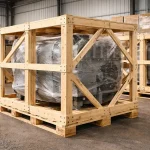
11.6 Arrange International Delivery
Confirm packing, dimensions, weights, shipping terms, customs documentation, and destination requirements.
12. How to Compare Total Cost of Ownership
Machine price is only one component of the investment.
12.1 Initial Costs
Include machine price, accessories, tooling, packing, freight, import charges, installation, and commissioning.
12.2 Operating Costs
Consider electricity, water, abrasives, cutting tools, labor, maintenance, and downtime.
12.3 Cost per Acceptable Finished Piece
A useful production measure is:
Cost per Acceptable Piece = Total Relevant Production Cost ÷ Number of Accepted Finished Pieces
This calculation should use consistent production conditions and quality requirements.
12.4 Evaluate Long-Term Productivity
A machine with a lower initial price may not provide the lowest operating cost.
Compare cutting quality, throughput, consumable consumption, reliability, and service requirements.
13. Common Mistakes When Buying Tile Cutting Machines
13.1 Choosing Based Only on Machine Price
Compare complete configurations and operating requirements.
13.2 Ignoring Material Differences
A machine suitable for standard ceramic tiles may not be suitable for thick or large-format porcelain slabs.
13.3 Overlooking Edge Quality
Cutting speed should not be evaluated separately from chipping, accuracy, and breakage.
13.4 Selecting Excessive Automation
Advanced equipment may not be justified for low production volumes.
13.5 Ignoring Water and Waste Management
Wet cutting and waterjet systems require suitable water and waste handling arrangements.
13.6 Skipping Production Tests
Sample cutting tests help verify suitability before shipment.
13.7 Underestimating Spare Parts
Confirm availability of cutting tools, consumables, pumps, drives, and other critical components.
14. Frequently Asked Questions
What is the best machine for cutting porcelain tiles?
The best machine depends on tile dimensions, thickness, cutting geometry, and production requirements. Suitable diamond blade machines, bridge saws, and other specialized systems may be considered.
What is the difference between a bridge saw and a waterjet cutter?
A bridge saw commonly uses a rotating blade for straight or selected angled cuts. An abrasive waterjet uses a high-pressure abrasive stream and can be suitable for complex shapes and decorative patterns.
Can CNC machines cut ceramic tiles?
Yes. Suitable CNC-controlled machines can cut ceramic or porcelain materials using compatible cutting technologies. Capabilities depend on the machine configuration.
Are automatic tile cutting machines suitable for mass production?
They can be suitable for repeated industrial cutting operations, provided that capacity, quality, handling, and integration requirements are met.
Can one machine cut both ceramic and porcelain tiles?
Some machines can process both, but tooling, cutting parameters, thickness limits, and quality requirements must be verified.
Is waterjet cutting better than diamond blade cutting?
Neither method is universally better. Diamond blade systems may be efficient for many straight cuts, while abrasive waterjet systems may be more suitable for complex shapes.
Should I buy a new or used tile cutting machine?
New equipment may offer current configurations and manufacturer support. Used equipment may reduce initial cost but requires inspection and evaluation of maintenance and spare-parts risks.
How do I check cutting accuracy before purchasing?
Request a cutting test using representative materials and agreed tolerances. Measure multiple finished pieces and document the results.
What information should I send to a Chinese machinery supplier?
Provide material type, tile dimensions, thickness, cutting geometry, required output, accuracy, automation preferences, budget, and destination country.
What should I check before importing a tile cutting machine?
Confirm machine specifications, safety requirements, inspection results, export packing, shipping terms, import regulations, installation needs, and after-sales support.
15. Source Ceramic Tile Cutting Machines with Machrix
Selecting a ceramic tile cutting machine requires careful consideration of material properties, cutting methods, production capacity, edge quality, and operating costs.
For small workshops, compact equipment may provide sufficient functionality.
For porcelain slab fabricators, cutting dimensions, machine stability, and handling systems are important.
For industrial tile manufacturers, automatic cutting systems may offer advantages when integrated with the overall production process.
Machrix Industrial is a Foshan-based machinery sourcing business connecting international buyers with Chinese machinery and industrial tool suppliers.
We welcome inquiries for new and used ceramic tile cutting machinery, subject to supplier availability and project requirements.
Tell Us About Your Tile Cutting Requirements
Please provide:
- Tile material
- Tile dimensions and thickness
- Required cutting shapes
- Desired cutting accuracy
- Production capacity
- Preferred cutting technology
- New or used equipment preference
- Available factory utilities
- Budget range
- Destination country
- Installation and technical support requirements
Submit Your Ceramic Machinery RFQ
Website: https://machrix.com/
Email: sales@machrix.com
Machine availability, technical specifications, inspection arrangements, supplier options, and commercial terms are subject to confirmation for each sourcing project.