Punching Aluminum Profiles with a Cordless Hydraulic Puncher: A Buyer’s Guide to Hinge, Drainage and Custom Hole Requirements
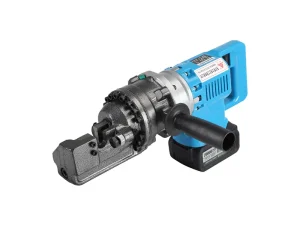
Choosing a cordless hydraulic puncher for aluminum profiles starts with the profile itself—not simply the fact that the workpiece is aluminum.
Two aluminum profiles made from the same alloy can have completely different section shapes, wall thicknesses, hole positions and access conditions. These differences can determine whether a standard punch and die can reach the workpiece or whether a different punch head, die configuration or custom tooling should be considered.
This guide explains what buyers should prepare before selecting an aluminum profile punching tool, particularly for hinge holes, drainage holes and custom hole requirements.
Important: Final tool compatibility should be confirmed using a profile drawing, clear photographs or a sample test. Tooling selection depends on the actual workpiece and punching geometry.
Why Aluminum Profile Geometry Matters for Punching
When choosing a puncher for aluminum extrusion, the material is only one part of the decision.
The following factors can affect tool selection:
- Profile cross-section
- Wall thickness
- Hole shape and dimensions
- Hole position
- Distance from the profile edge
- Available working clearance
- Access from the opposite side
- Required hole tolerance
- Production quantity
- Whether standard or custom tooling is required
For this reason, asking for an aluminum profile puncher based only on the alloy or hole diameter can result in an incomplete tool selection.
The first step should always be to understand the geometry of the actual profile.
1. Start with the Aluminum Profile Section, Not Just the Material
Look at the aluminum extrusion in cross-section.
Is it:
- A simple channel profile?
- A hollow aluminum section?
- A window or door frame profile?
- A structural frame extrusion?
- A multi-chamber profile?
- A custom aluminum extrusion?
Then identify which face needs to be punched and whether the opposite side provides enough room for the die.
Profile Access Can Be as Important as Hole Size
For a cordless hydraulic puncher for aluminum profiles, physical access can be just as important as the diameter or shape of the hole.
A narrow opening, deep return, internal chamber or obstruction close to the punching point may affect:
- Required throat depth
- Punch head orientation
- Die position
- Tool accessibility
- Whether standard tooling can be used
- Whether custom tooling needs to be considered
A simple cross-section sketch with the hole position clearly marked can therefore be more useful than simply stating:
“We need to punch aluminum.”
What Should You Mark on the Drawing?
Ideally, identify:
- The face to be punched
- Hole center position
- Distance from the nearest edge
- Profile width and height
- Wall thickness
- Internal obstructions
- Available space for the punch and die
If a technical drawing is not available, photographs can still be useful.
Take one photograph of the complete aluminum profile and another close-up showing the exact punching area.
2. Information to Prepare Before Choosing an Aluminum Profile Puncher
Before asking a supplier to recommend a cordless aluminum profile punching tool, prepare as much of the following information as possible.
Profile Information
Provide a cross-section drawing or clear photographs of the extrusion.
Include the outside dimensions whenever possible.
Material and Wall Thickness
Provide:
- Aluminum alloy or material grade, if known
- Wall thickness at the punching location
- Whether the thickness changes around the hole
The wall thickness at the actual punching point is particularly important.
Hole Type
Specify whether the application requires:
- Round holes
- Oblong holes
- Slot holes
- Hinge holes
- Drainage holes
- Mounting holes
- Other custom shapes
Hole Size and Tolerance
Provide:
- Hole diameter
- Hole length and width for slots
- Required tolerance, if applicable
- Any requirements concerning burrs or hole finish
Hole Position
Show:
- Punching face
- Edge distance
- Hole-to-hole spacing
- Distance from corners
- Angle or offset, if applicable
Production Quantity
Tell the supplier:
- Holes per workpiece
- Number of workpieces
- Expected daily or monthly quantity
- Whether the same hole pattern is repeated
Working Conditions
Safety is another important consideration when selecting a punching tool.
Cordless hydraulic punchers eliminate the external high-pressure hose between the pump and punching head, reducing hose-related handling issues and making the work area less cluttered.
Some modern models also include features such as:
- Automatic punch retraction
- Pressure monitoring
- Manual pressure release
- Intelligent punching detection
- Work lights
- Rotating heads
For example, Bosch’s cordless hydraulic punching tool incorporates automatic retraction, electronic pressure monitoring and manual pressure release.
Traditional hydraulic systems can also be very safe when correctly operated and maintained. However, high-pressure hoses and hydraulic connections require appropriate inspection and handling.
Safety should always follow the manufacturer’s operating instructions and maintenance requirements.
3. Match the Punch, Die and Punch Head to the Profile Geometry
The punch and die should always be considered as a working pair.
The following factors need to be checked together:
- Hole shape
- Hole dimensions
- Wall thickness
- Profile geometry
- Punching direction
- Available clearance
- Die support
- Required hole finish
The die must also have a stable position on the opposite side of the workpiece.
Standard Tooling vs. Custom Tooling
For common aluminum profile applications, standard punch and die configurations may be suitable.
For more unusual profiles or hole requirements, however, a different punch head, die configuration or custom punch and die may need to be considered.
DEKIN MASTER’s catalog includes an Aluminum Alloy Series, with configuration directions such as Al-Hinge Holes and Al-Drain Holes. These can serve as useful starting points for discussing an application, but they should not be treated as a universal setup for every aluminum extrusion.
The final configuration should be confirmed against the actual profile.
When the geometry is unusual, a sample test can provide additional confirmation before production.
4. Hinge Holes and Drainage Holes: What Is Different?
Hinge and drainage applications can both involve aluminum profiles, but their hole requirements and positioning can be different.
Hinge Holes
Hinge holes generally require consistent positioning so that the hole pattern works correctly with the hinge hardware.
Before selecting an aluminum hinge hole puncher, confirm:
- Hole shape
- Hole diameter or dimensions
- Center-to-edge distance
- Hole spacing
- Hinge hardware dimensions
- Clearance around the hinge area
- Profile geometry around the punching location
A small change in the profile section can affect the required head orientation or die position.
For repetitive production, consistent hole positioning is particularly important.
Drainage Holes
Drainage holes are often located near a low point or within a concealed channel, depending on the design of the finished assembly.
The actual requirement can vary significantly between profiles.
Confirm whether the required opening is:
- Round
- Slot-shaped
- Oblong
- Custom-shaped
Also tell the supplier whether the finished application has requirements for:
- Visible-surface appearance
- Burr control
- Hole position
- Internal clearance
- Drainage path
A cordless hydraulic puncher for aluminum profiles should therefore not be selected from the hole diameter alone.
Profile access, support and die position are part of the same technical decision.
5. When Should You Consider Custom Punch and Die Tooling?
Standard tooling is often the first option to check.
Custom tooling becomes more relevant when the profile or hole requirement does not match a standard configuration.
Examples can include:
- Non-standard hole shapes
- Special hinge holes
- Custom drainage slots
- Unusual hole positions
- Limited access
- Deep or narrow profile sections
- Multiple hole patterns
- Special clearance requirements
Custom Tooling Should Start with the Workpiece
A supplier should normally review the actual geometry before confirming a custom solution.
Useful information includes:
- Profile drawing
- Material and wall thickness
- Hole dimensions
- Hole position
- Required tolerance
- Production quantity
- Photos of the actual application
If possible, provide a physical sample for testing.
This reduces the risk of developing tooling around an incomplete understanding of the profile.
6. Can One Puncher Handle Multiple Aluminum Profile Applications?
Potentially, but this depends on the tool configuration.
When one project involves several hole shapes or profile types, ask whether the selected cordless hydraulic punching tool supports interchangeable punches and dies.
An interchangeable tooling approach may allow one compatible puncher platform to be used for different applications without requiring a completely different tool for every hole pattern.
However, compatibility should be checked for each application.
The Key Question to Ask a Supplier
The key question is not simply:
“Can the puncher make different holes?”
Instead, ask:
“Can this puncher, with the appropriate punch and die configuration, safely reach and support each of our actual profiles?”
For more information about interchangeable tooling, see our guide:
Customizable Die Heads and Interchangeable Punch Dies for Diverse Construction Needs
7. A Simple Confirmation Process Before Ordering
A structured confirmation process can make the purchasing decision much clearer.
Step 1 — Share the Basic Workpiece Information
Provide:
- Profile drawing or photographs
- Wall thickness
- Hole dimensions
- Hole position
- Required quantity
- Working conditions
Step 2 — Review the Proposed Tool Configuration
Confirm:
- Punch type
- Die type
- Punch head style
- Working clearance
- Access dimensions
- Required accessories
Make sure the proposed setup is checked against the actual profile rather than a generic aluminum sample.
Step 3 — Test a Sample When the Geometry Is New
For an unusual profile, use a real workpiece or representative sample whenever possible.
The test should confirm:
- Tool reach
- Punch and die fit
- Access
- Hole position
- Hole shape
- Required hole finish
Step 4 — Confirm the Complete Package
Before placing the order, confirm the complete configuration, including:
- Cordless puncher
- Punches
- Dies
- Punch head or head assembly
- Accessories
- Batteries
- Charger
- Optional power adapter, if applicable
- Packaging
Step 5 — Confirm Commercial Details
Ask the supplier to confirm:
- Quotation
- MOQ, if applicable
- Lead time
- Tooling cost
- Spare punch and die availability
- Battery and charger configuration
- Sample-testing arrangements
This separates the technical decision from assumptions and gives both sides a clear record of what has been checked before a purchase order is placed.
8. Common Buying Mistakes When Punching Aluminum Profiles
Several common mistakes can make tool selection more difficult.
Choosing by Hole Diameter Alone
A 10 mm hole, for example, does not tell the supplier enough information to determine whether a tool can reach the workpiece.
The profile section and hole location matter too.
Ignoring the Opposite Side of the Profile
The punch may reach the desired location while the die cannot be positioned correctly.
Always show the opposite side of the profile.
Providing Only the Material Grade
Knowing that the workpiece is aluminum is useful, but it does not describe its geometry.
The same aluminum alloy can be used in many different extrusion designs.
Waiting Until After Ordering to Discuss Custom Tooling
If the profile has unusual geometry, discuss tooling before placing the order.
Early review can help determine whether standard tooling is sufficient or whether a custom solution needs to be evaluated.
Skipping Sample Testing for Unusual Applications
When the profile geometry is new or complicated, sample testing can reduce uncertainty before production.
9. What Should You Send a Supplier for a Fast Recommendation?
If you want a supplier to recommend a cordless hydraulic puncher for aluminum profiles, the following checklist is a useful starting point.
Information | What to Provide |
Profile | Drawing or clear photos |
Profile dimensions | Width, height and other key dimensions |
Material | Aluminum alloy or grade, if known |
Wall thickness | Thickness at the punching point |
Hole type | Round, slot, hinge, drainage or custom |
Hole size | Diameter or length × width |
Hole position | Edge distance and spacing |
Tolerance | Required tolerance, if applicable |
Quantity | Holes per piece and expected production volume |
Access | Available space around the punching point |
Finish | Burr or appearance requirements |
Sample | Physical profile, if available |
The better the information, the more accurately the supplier can evaluate the required punch, die and head configuration.
Frequently Asked Questions
When the profile geometry is new or complicated, sample testing can reduce uncertainty before production.
Can one cordless puncher handle every aluminum profile?
Not necessarily.
Different aluminum extrusion sections, wall thicknesses, hole shapes and access conditions may require different punches, dies or punch head configurations.
The actual profile should be reviewed before confirming compatibility.
What if I only know the hole size?
Hole size is a useful starting point, but it is not enough by itself.
Also provide:
- Profile cross-section
- Wall thickness
- Hole position
- Overall profile dimensions
- Photograph of the punching area
Can non-standard hinge or drainage holes be customized?
Some non-standard requirements may be suitable for a custom punch and die or customized head configuration.
However, feasibility should be reviewed from the actual drawing or sample before production.
Can the same puncher be used for different hole shapes?
Depending on the tool design and application, interchangeable punches and dies may allow different hole configurations to be used with the same compatible puncher platform.
Each profile and hole configuration should still be checked individually.
How do I reduce the risk of a poor tooling fit?
Provide the exact hole location, profile cross-section, wall thickness and photographs showing both sides of the profile.
For unusual applications, confirm the configuration through a sample test before production.
Should I buy the puncher first and choose the dies later?
For standard applications, a modular tooling approach may be possible.
For unusual aluminum profiles, it is generally better to evaluate the puncher, punch, die and profile together before ordering.
This helps avoid selecting a tool that cannot reach or properly support the intended punching position.
Prepare a Clearer Aluminum Profile Punching Inquiry
Choosing the right aluminum profile punching tool is not simply a matter of selecting the correct hole diameter.
The profile geometry, wall thickness, hole position, access conditions and tooling configuration all need to work together.
If your application involves standard hinge holes, drainage holes or custom-shaped openings, prepare the profile information first and then evaluate the compatible puncher and tooling combination.
For more information, see our:
- Cordless Puncher Product Overview
- Guide to Customizable Die Heads and Interchangeable Punch Dies
- Workpiece-Based Cordless Puncher Selection Guide
Ready to Discuss Your Aluminum Profile Project?
Send us your profile drawing or clear photos, wall thickness, hole size and position, production quantity and access limitations.
Our team can review the application and discuss the appropriate punch, die and tooling direction based on your actual aluminum profile.
The final configuration should be confirmed through the relevant technical information and, where necessary, sample testing before production.