What Does Throat Depth Mean in a Cordless Puncher? How to Choose the Right Model
Throat depth determines how far a cordless puncher can reach from the material edge to the hole center. Learn how to measure it and choose the right tool for angle iron, plates, C-sections, purlins, and guardrails.
When choosing a cordless puncher, many buyers focus first on punching force, motor power, or maximum hole size. These specifications are important, but they do not answer one practical question:
Can the puncher physically reach the required hole position on your material?
That is what throat depth helps you determine.
A puncher may have enough punching force and support the required hole diameter, but if its punch head cannot reach the hole location, it may not be suitable for the application.
Understanding throat depth before purchasing can therefore help buyers avoid choosing a tool based only on punching force or hole size.
What Is Throat Depth in a Cordless Puncher?
Throat depth is the distance from the front of the punch head to the centerline of the punch.
In simple terms, it describes how far the punch can reach into the workpiece from its accessible edge.
Before selecting a cordless puncher, measure the distance from the edge of the material to the center of the hole that needs to be punched.
The required throat depth should be equal to or greater than this distance, while the material thickness, hole size, punch-and-die configuration, and workpiece geometry must also be within the tool’s working range.
Example of Throat Depth Measurement
For example, if the center of the required hole is 35 mm from the accessible edge of the material, a cordless puncher with a 42.9 mm throat depth may be suitable.
However, throat depth alone does not confirm compatibility.
You should also check:
- Material type
- Material thickness
- Hole diameter or shape
- Punch and die configuration
- Workpiece profile
- Punching direction
- Clearance around the punching area
The actual workpiece should always be checked against the specifications of the selected model.
Why Does Throat Depth Matter?
A cordless puncher can have sufficient punching force and the correct die, but it may still be unsuitable if the punch head cannot physically reach the required hole position.
Throat depth is particularly important when working with structural profiles and components such as:
- Angle iron
- Angle steel
- Flat plates
- Connection plates
- C-sections
- Purlins
- U-sections
- PV mounting brackets
- Highway guardrails
Workpiece Geometry Can Affect Reach
The shape of the workpiece is just as important as the throat-depth specification.
For example, a C-section or purlin may have a web and flanges that restrict the direction from which the punch head can enter.
Nearby:
- Flanges
- Bends
- Corners
- Reinforcing sections
- Adjacent surfaces
may interfere with the punch head or die.
Therefore, a nominal throat-depth number should not be considered independently from the actual profile.
How to Choose the Right Throat Depth
Choosing the correct throat depth starts with the workpiece rather than the tool.
1. Measure the Hole Center Distance
Measure from the accessible edge of the material to the center of the hole.
Do not measure only to the nearest edge of the hole.
For example:
Material edge → hole center = required reach
If a series of holes needs to be punched, check the hole that is farthest from the accessible edge.
This measurement will generally determine the minimum throat depth required for the application.
2. Check the Material Profile
For angle iron, C-sections, purlins, and other structural profiles, also check:
- Section width
- Section height
- Material thickness
- Flange dimensions
- Web position
- Hole position
- Available clearance
- Punching direction
The question is not simply whether the stated throat depth is large enough.
The punch head must also be able to enter the profile and position the punch and die correctly.
3. Match the Throat Depth to the Application
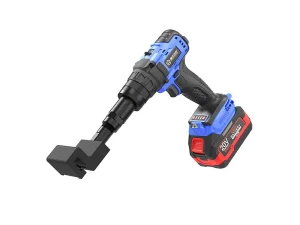
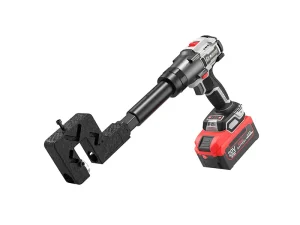
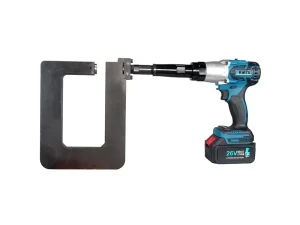
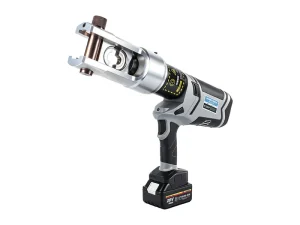
DEJIN MASTER cordless punchers are available with different throat-depth configurations for different working conditions.
Typical application references include:
| Throat Depth | Typical Application Reference |
|---|---|
| 42.9 mm | Many angle iron and angle steel punching applications |
| 70 mm | Many flat plate applications where holes are farther from the edge |
| 200 mm | Bottom-hole punching of C-sections and purlins |
| 210 mm | Applications such as highway guardrails requiring deeper reach |
These figures are application references rather than universal recommendations.
The correct model still needs to be checked against the actual profile, material thickness, hole position, punching direction, and punch-and-die requirements.
Throat Depth Is Not the Same as Hole Size
Several cordless puncher specifications are sometimes confused during purchasing.
Throat depth, aperture, material thickness, and punching force describe different characteristics of the tool.
Throat Depth
Throat depth describes:
How far the punch can reach from the accessible material edge to the hole center.
Aperture or Hole Size
Aperture refers to the size and shape of the hole that the punch-and-die set can produce.
Examples include:
- Round holes
- Slotted holes
- Other application-specific hole shapes
Material Thickness
Material thickness refers to the thickness of the metal being punched.
The selected puncher must have sufficient capacity for the actual material thickness.
Punching Force
Punching force describes the force available to deform and cut the material.
A tool may have sufficient punching force and support the required hole diameter but still be unsuitable if its throat depth is insufficient.
Conversely, a tool may have sufficient reach but require a different punch-and-die configuration for the requested hole shape.
Common Throat Depth Applications
Different workpieces can require significantly different punching reaches.
Angle Iron and Angle Steel
For angle iron and angle steel, hole positions are often relatively close to the accessible edge.
A compact throat-depth configuration may therefore be suitable for many applications.
However, the angle dimensions, flange position, material thickness, and hole location should still be checked.
Flat Plates and Connection Plates
Flat plates can require a greater reach when the hole is positioned farther from the edge.
A deeper throat configuration may therefore be appropriate for certain connection or fabrication applications.
C-Sections and Purlins
C-sections and purlins can present a different challenge because the punch may need to work through the bottom or web area of the profile.
For these applications, punching direction and profile geometry are especially important.
A longer throat depth does not automatically mean that every C-section or purlin can be punched.
Highway Guardrails
Highway guardrails can involve hole positions that require a deeper reach.
A throat depth around 210 mm can support certain guardrail punching applications, subject to the actual material and hole requirements.
Side-Hole Punching vs. Bottom-Hole Punching
Another important consideration is the direction from which the hole must be punched.
Side-Hole Punching
Side-hole punching generally involves positioning the punch head from the side of the workpiece.
This configuration can be useful for applications where the hole is accessible from the profile edge.
Bottom-Hole Punching
Bottom-hole punching can be important for profiles such as C-sections and purlins.
The punch head must have sufficient reach and clearance to position correctly within the profile.
For this reason, buyers should provide the profile drawing or clear workpiece photos when asking a supplier to recommend a model.
What Should You Confirm Before Ordering?
Before requesting a quotation or selecting a cordless puncher, prepare the following information.
Material Information
Provide:
- Material type
- Material grade, if relevant
- Material thickness
- Profile shape
- Profile dimensions
Hole Information
Specify:
- Hole diameter
- Slot dimensions
- Hole shape
- Hole center position
- Hole spacing
- Required punching direction
Workpiece Information
Where possible, provide:
- Profile drawings
- Engineering drawings
- Clear photos
- Dimensions of the section
- Photos showing the required hole position
Working Requirements
Also explain:
- Expected punching quantity
- Working frequency
- On-site or workshop use
- Required portability
- Whether different hole sizes are needed
This information allows the supplier to evaluate the punch head, throat depth, die arrangement, and power configuration together.
Working Requirements
Before purchasing a cordless puncher, use this checklist:
✓ Measure the farthest hole center from the accessible edge.
✓ Confirm the material profile and dimensions.
✓ Check the material thickness.
✓ Confirm clearance around the punch head and die.
✓ Select the correct round or slotted punch-and-die configuration.
✓ Confirm whether the application requires side-hole or bottom-hole punching.
✓ Check the required punching direction.
✓ Provide a profile drawing or clear photos when possible.
✓ Confirm the complete tool configuration with the supplier.
Choose Throat Depth Based on the Actual Job
Throat depth is one of the most important practical specifications when selecting a cordless puncher for structural profiles and metal fabrication.
The key measurement is simple:
Material edge to hole center = required punching reach.
However, the final tool selection should not be based on this measurement alone.
The material profile, thickness, hole size, hole shape, punching direction, die configuration, and available clearance must also be considered.
The right throat depth helps prevent a common purchasing mistake: choosing a puncher based only on punching force or hole diameter while overlooking whether the punch head can physically reach the required hole position.
Send your material profile, thickness, hole drawing, and working photos to DEJIN MASTER. Our team can help evaluate the suitable throat-depth configuration, punch-and-die arrangement, and cordless punching solution for your project.